Why Homes Feel So Expensive (And What’s Actually Behind It)

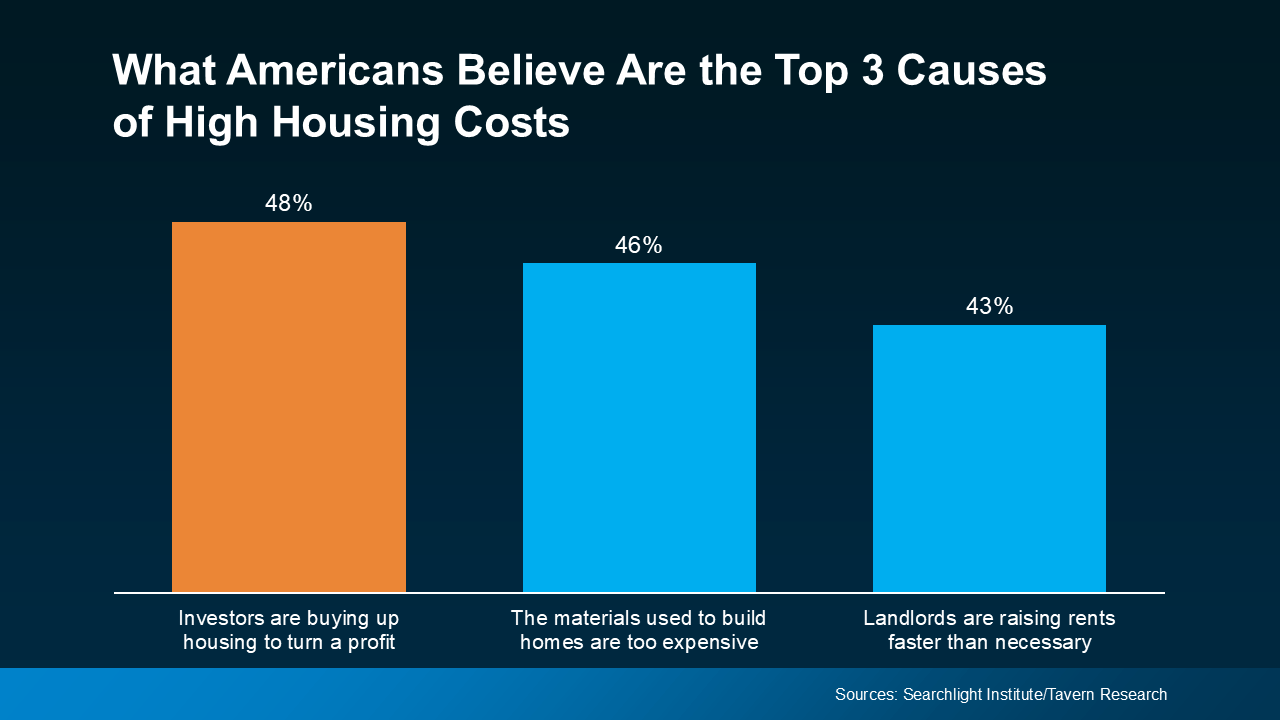
Scroll through your feed and you’ll see plenty of people blaming investors for today’s high home prices. And according to a recent national survey, nearly half of Americans (48%) believe that’s the main reason housing feels so expensive (see graph below):
But when you dig into the data, that story doesn’t hold up.
What the Numbers Actually Show
Yes, investors have a presence in the housing market, especially in certain neighborhoods, but they’re not taking over the market like many assume.
In fact, Realtor.com reports that only 2.8% of all home purchases last year were made by large investors (those owning more than 50 properties). That means roughly 97% of homes were bought and sold by everyday people, not corporate buyers. Danielle Hale, Chief Economist at Realtor.com, explains:
“Investors do own significant shares of the housing stock in some neighborhoods, but nationwide, the share of investor-owned housing is not a major concern.”
So, if it’s not investors, what’s really pushing prices higher?
What’s Really Behind Today’s Home Prices
The biggest factor isn’t who’s buying, it’s what’s missing. There simply aren’t enough homes to go around. Robert Dietz, Chief Economist at the National Association of Home Builders (NAHB), says:
"It's been popular among some to blame investors, but with housing, the economics of that don't make a lot of sense. The fundamental driver of housing costs is the shortage itself—it's driven by the fact that there's a mismatch between the number of households and the actual size of the housing stock."
In short, supply hasn’t kept up with demand. And that imbalance, more than anything else, is what’s driving prices up across the country.
Bottom Line
It’s easy to point fingers, but investors aren’t the main reason homes cost so much. The real challenge is the ongoing shortage of available homes.
The good news? More new listings and construction are slowly coming to market. That shift could make buying feel more achievable again.
Let’s connect to talk about what this means for you and what’s happening right now in our local market.
The information and opinions in this article are not investment advice. Tim Stice makes no guarantees about accuracy or completeness. Always do your own research and consult a professional before making financial decisions. Tim Stice is not liable for any loss or damage resulting from reliance on this content.
Tim Stice, Broker Realtor | Hawaii Life | Maui, Hawaii | Real Estate Agent
The information and opinions in this article are not investment advice. Tim Stice makes no guarantees about accuracy or completeness. Always do your own research and consult a professional before making financial decisions. Tim Stice is not liable for any loss or damage resulting from reliance on this content.
Tim Stice, Broker Realtor | Hawaii Life | Maui, Hawaii | Real Estate Agent